
My house Detroit, Michigan
I spent most of my early life in Detroit, never living more than a block from where I was born. A child’s world-view can be naive. Our neighborhood was ethnically diverse, so I assumed most of the country was the same. The more I travelled, the more I became aware of regional differences. When I lived on the East Coast I learned you drink soda, not pop. Water comes from a spigot not a faucet, and people go to the shore not the beach. Living in the South taught me that when someone said “Well, Bless her heart,” it was not meant as a compliment. I hadn’t really thought much about how where I lived influenced my language, philosophy and even aesthetics.
I recently had the pleasure of meeting Fulbright scholar Viktor Susak from L’viv, Ukraine. He is working on project titled, “The Concept of Regionalism as a Cognitive Approach to Explaining Macrostructural Social Interactions.”
That got me thinking about regionalism in art. I’m not an art historian, so I won’t be exploring this in a scholarly manner. I just wonder with the exposure art has via the Internet these days can regionalism still exist? Are artists in the Midwest that different than the East and West Coast artists? I found the panel discussion below at the Glasstire, a website about visual art in Texas. The panel of notables discussed their views on the concepts of Regionalism vs. Nationalism vs. Cosmopolitanism.
One of them mentioned the notion of terroir as it relates to the wine production. It’s a philosophical belief that a wine possesses a sense of place, or ‘somewhereness’. So a wine from a particular soil expresses characteristics related to the physical environment in which the grapes are grown.

Women’s Caucus for art tour of Diego Rivera mural at the Detroit Institute of Art
To quote recently deceased art critic
Robert Hughes. Diego Rivera “became a symbol, the key figure in cultural transactions between North and Central America in the first half of the 20th century.” “Few 20th century artists have been as popular in their own societies. None is more relevant to the debate over ‘indigenous,’ or ‘national,’ art language as against ‘international style.’ The mural above created as a tribute to Detroit’s industry of the time, would not be as meaningful if it were in a different city. It was created for this specific place.
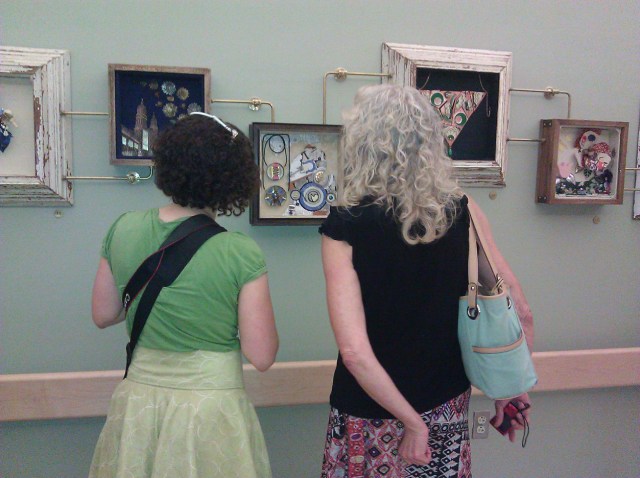
Women’s Caucus for Art members viewing UM Gifts of Art collection
Our Michigan Women’s Caucus for Art chapter recently hosted women artists from across the country. We took them on a our tour of our regional art scene in Ann Arbor and Detroit. The photo above is from our first stop at the Gifts of Art Program and University of Michigan Hospital in Ann Arbor, Michigan.

Artist Mike Sivak at Ann Arbor Art Fair
The Ann Arbor Art Fairs have been filling the streets of Ann Arbor with Art for over 50 years. Originally drawing from regional artists and arts group. Today the fairs have booths for over 700 artists from around the country.

Poster at Lincoln St. Sculpture Park, Detroit
Pockets of visual art are helping the city’s renaissance. Lincoln Street Art Park was founded in fall of 2011 as a collaboration between local artists and sculptors, Recycle Here!, Detroit Synergy, Midtown Detroit Inc., Michigan Council on Arts and Cultural Affairs, and the Detroit Recreation Department. It continues to grow and evolve as an active public space for connecting and interacting with art.
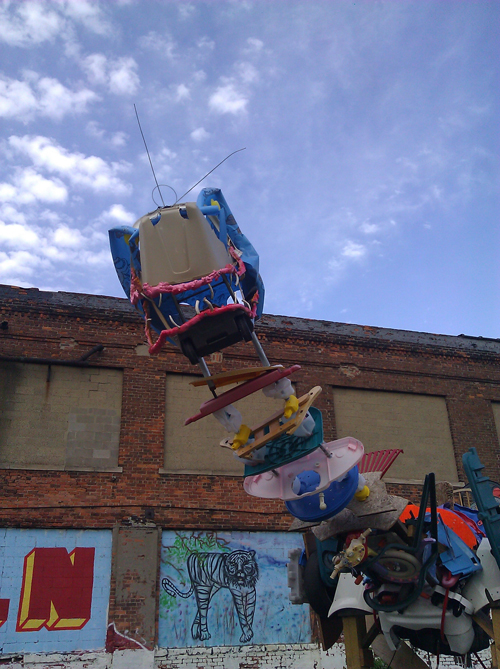
Lincoln St. Sculpture Park, Detroit
Uncle Frank the Dinosaur, a towering construction of recycled materials found throughout the city. The sculpture was created by Kelly Kaatz, Janice Polzin and Matt Pawenski for the Detroit Electronic Movement Festival.
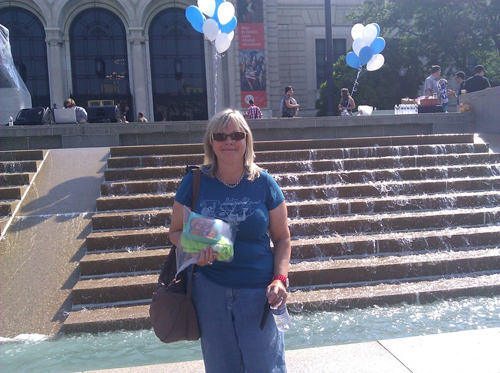
Free Art Friday at the Detroit Institute of Art
I keep thinking of this quote I heard years ago from an IHM nun, “grow where you are planted.” Which I never fully understood until I became an adult. So here I am making the best of where I am and remembering where I have been.



 Barbara Melnik Carson
